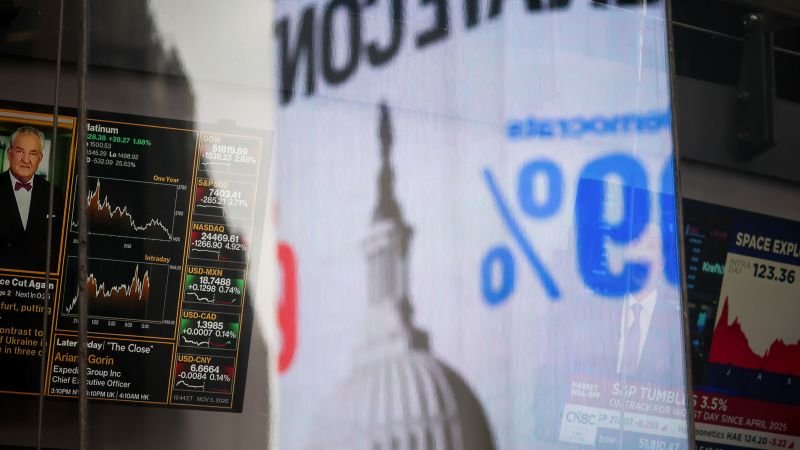
Televisions broadcast market news at the Nasdaq MarketSite in New York, on Thursday.
A staggering $2.5 trillion in value evaporated from the tech-heavy Nasdaq on Thursday as Wall Street rallied Wednesday morning as investors reacted positively to Democratic gains. By Thursday, however, that optimism had been replaced by fears that Democrats might leverage their new political standing to implement stricter regulations and curb the AI buildout.
Consider Texas, for example. Democratic Gov.-elect Gina Hinojosa campaigned on temporarily halting new data center construction and rolling back certain tax incentives for companies building them in the state. Those pledges are now adding to investor concerns about the future of the AI boom.
“What will happen is a day or two from now, people will realize that this isn’t the end,” said Jamie Cox, managing partner at Harris Financial Group. Companies will pour more money into increasing the capacity of existing data centers, he predicts.
Hedge funds, some of which borrow money to make bigger bets on stocks, then entered the story, amplifying the losses, Cox said.
Borrowing allows funds to make bigger investments than they could with their own cash, magnifying both gains and losses. As the value of their investments drops, funds that borrowed to buy those stocks can face demands from lenders or brokers to put up more cash or collateral. If they can’t, they may have to sell stocks to raise the money.
Such liquidation can drive stock prices lower, triggering a negative feedback loop: declining valuations lead to further margin calls, which necessitate additional selling and push prices down further.
Thursday’s moves “are not indicative of a crash or any type of impending disaster,” Cox said. Rather, it’s “companies that have gotten way over their skis and leverage.” (Leverage refers to the act of borrowing money to buy more assets.)
The selling driven by hedge funds could take a few more days to fully play out, maintaining pressure on stocks even if the initial political reaction begins to subside.
This highlights a significant vulnerability within the AI trade: the more capital investors borrow to wager on the sector’s growth, the more severe the consequences can be when market confidence begins to waver.