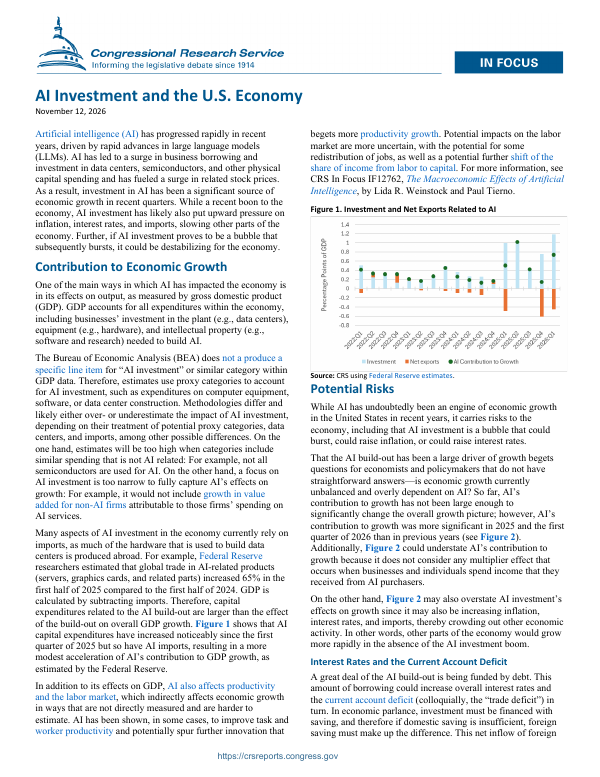
Artificial intelligence (AI) has evolved at a rapid pace in recent years, largely propelled by breakthroughs in large language models (LLMs). This progress has triggered a spike in corporate borrowing and capital expenditure directed toward semiconductors, data centers, and other physical infrastructure, while simultaneously driving up related equity valuations. Consequently, AI-related investment has served as a primary engine for economic expansion over the last few quarters. Although this trend has provided a recent boost to the economy, it has likely exerted upward pressure on inflation, and imports, which may be tempering growth in other sectors. Furthermore, should this AI investment wave prove to be a bubble that eventually collapses, it could pose significant risks to economic stability.
Contribution to Economic Growth
One of the primary ways AI has influenced the economy is through its impact on output, typically tracked. GDP measures all expenditures within the economy, including business investments in physical plants like data centers, hardware equipment, and the intellectual property—such as research and software—required to develop AI technologies