China -12% and Japan -5% in the third quarter, but Korea -18%
US S&P 500 and Nasdaq 100 rise rather than rise
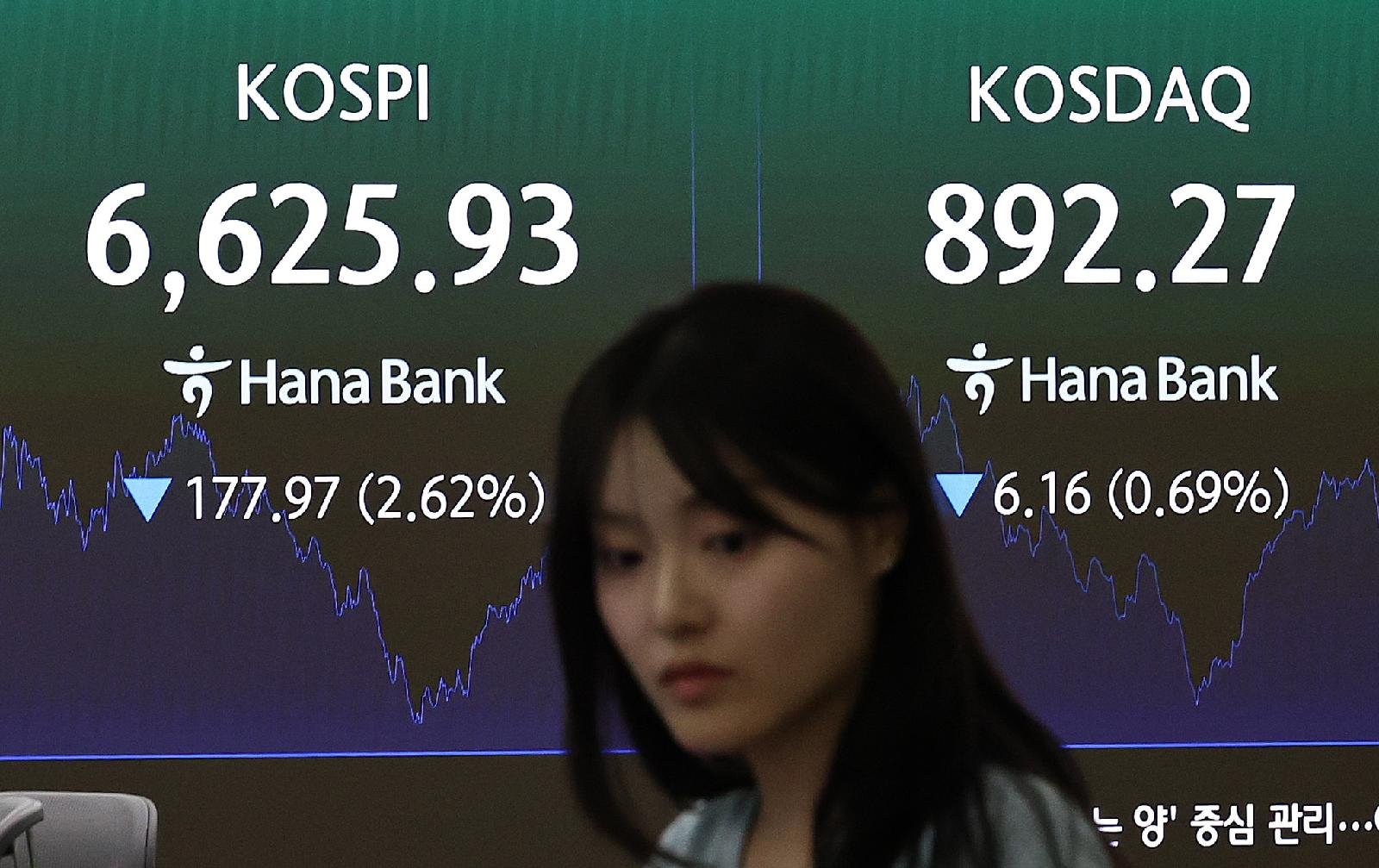
On the 8th, ahead of the holiday, the market conditions such as KOSPI are displayed on the dealing room of Hana Bank’s headquarters in Jung-gu, Seoul. The KOSPI closed at 6625.93, down 177.87 points (2.62%) from the previous day, and the KOSDAQ index also closed at 892.27, down 6.16 points (0.69%).
Among the world’s major stock markets in the third quarter of this year, the slump in the Korean stock market was particularly noticeable. Driven by the AI semiconductor rally, the KOSPI had surged 60 percent this year—matching Taiwan for the highest gain globally—but experienced a sharp sell-off led by memory chip stocks as the AI craze cooled in early July. Unlike the U.S. S&P 500 and Nasdaq 100, which maintained their upward trajectory during the same period, the KOSPI declined by nearly 18%.
According to the Korea Exchange on the 11th, the KOSPI dropped from 8303.41 on July 1 to 6838.04 on September 30. Over this three-month span, the rate of decline reached 17.65%. As of the closing price on the 8th, the index stood at 6625.93.
During that same period (July 1 to September 30), China’s CSI300 index fell 12.13% from 4958.98 to 4357.62, while Japan’s Nikkei 225 Index retreated 4.74% from 77.96 to 66,753.72. Conversely, the U.S. stock market trended in the opposite direction. The S&P 500 climbed 2.25% from 7483.23 to 7651.54, and the Nasdaq 100 rose 2.01% from 29,809.13 to 34,408.50.
The relative weakness of the Korean stock market among major nations is striking. Specifically, the KOSPI fell 25% by the end of September compared to the annual high of 914.55 (based on closing price) recorded on June 22. Nevertheless, compared to the end of last year, it remains up by more than 62%.
In the third quarter, the KOSPI faced headwinds from both domestic and internationalacross major economies, fueled by the prolonged war in the Middle East, negatively impacted the market. Furthermore, concerns regarding a “peakout” in the semiconductor industry and a spike in U.S. government bond yields dampened investor sentiment worldwide
The index, which had plunged to 5,262.77 during the day at the end of July, managed to rebound as global semiconductor adjustments concluded and authorities regulated single-stock leveraged products related to “Samjeon and Nix.”
Samsung Electronics and SK Hynix.
Market attention is now focused on whether the KOSPI can recover its third-quarter losses during the fourth quarter. Experts identify a lack of liquidity to drive index growth as the primary reason for the KOSPI’s recent sluggishness.
Kim Dae-joon, a researcher at Korea Investment & Securities, said, “The liquidity of the Korean stock market is depleted compared to the first half of the year,” adding, “It will be difficult to expect a steep recovery of large-cap stocks in this situation.” The daily average transaction value of the KOSPI, which stood at 50.3471 trillion won in June, fell 57% to 21.36 trillion won last month.
In particular, foreign investors are pulling out of Korea. Kim Jae-seung, a researcher at Hyundai Motor Securities, said, “Rather than fundamental factors, individual investors have been in the loss section in the bear market since June, undermining investor sentiment, and net selling by foreign investors is also continuing.”
According to Hyundai Motor Securities, foreign investors net sold 21.6 trillion won on the KOSPI between September and October, with net sales of 5.2 trillion won and 12 trillion won in Samsung Electronics and SK Hynix, respectively. Samsung Electronics’ foreign ownership ratio is currently at its lowest point in a decade.
“The global stock market is paying attention to the initial public offering (IPO) of artificial intelligence (AI) company Antropic and the U.S. midterm elections in the fourth quarter,” said Kim Jae-seung, a researcher. “In general, the U.S. stock market and the KOSPI have weakened since September ahead of the U.S. midterm elections, but they tend to gradually rebound from mid-October.”
The Yeouido stock market.
Corporate <a Rising interest rates could put additional burden on market returns." This perspective anticipates that the earnings growth of Korean companies will continue as U.S. hyperscalers—superscale data center operators—maintain their investment levels.
Samsung Electronics announced on the 8th that its operating profit for the third and fourth quarters was tentatively tallied at 107.4 trillion won, an increase of 782.5% year-on-year. It became the first Korean company to exceed 100 trillion won in quarterly operating profit.
Han Ji-young, a researcher at Kiwoom Securities, said, “As the market’s eye level on semiconductor stocks has risen, the focus is shifting toward profit sustainability after next year rather than performance for the rest of this year,” adding, “There is a limit to making mid-term business decisions until 2028 based on the results.”
The upcoming U.S. midterm elections on November 3 also represent a key variable.
Lee Kyung-soo, a researcher at Hana Securities, said, “As a result of analyzing six cases of mid-term elections since 2000, we recorded positive (+) performance (average +3.6%) by the end of the year from 5.”
“In 2018, the worst case, the S&P 500 plunged 14% by the end of the year in the aftermath of the Republican Party’s crushing loss of 41 House seats due to the highlight of the judgment against then-President Trump, but a strong rebound was seen from the beginning of the following year,” he added.
International oil prices are also viewed as a significant factor. Should oil prices stabilize, the inflation and interest rates would likely ease, improving foreign supply and demand and strengthening the stock market’s upward momentum.
Daishin Securities stated in a report on the 6th, “If there is no additional surge in oil prices and interest rates, the direction of the stock market is upward,” adding, “The KOSPI’s leading price-earnings ratio (PER) of less than 6 times has higher potential for upside than downside risks.”