Gold prices experienced another significant weekly decline as an initial recovery—fueled by falling oil prices and a softer U.S. dollar—was eclipsed by hotter-than-anticipated inflation data, rising Treasury yields, and increasingly hawkish Federal Reserve expectations. These factors pushed the precious metal to its lowest level in over a year.
Spot gold began the week trading at $4,066.39 per ounce on Sunday evening. The metal climbed sharply on Monday as renewed U.S.-Iran diplomatic efforts helped alleollar provided support for precious metals. This recovery lifted gold back above $4,100, with spot prices reaching a weekly high of $4,148.95 per ounce on Monday before sellers re-entered the market ahead of Tuesday’s consumer inflation report
The downward trend accelerated on Tuesday morning after October CPI rose 0.4%, surpassing forecasts, while core inflation also exceeded expectations. These stronger inflation figures revived speculation that the Fed might implement a 50-basis-point rate hike in December, driving Treasury yields and the dollar higher. Gold broke decisively below $4,000 per ounce on Wednesday as hawkish comments from Fed officials reinforced expectations for further tightening, overwhelming safe-haven demand despite ongoing tensions involving Iran and the Strait of Hormuz.
Selling pressure intensified on Thursday as Treasury yields neared 5% and the dollar strengthened. Continued uncertainty regarding the Middle East conflict and the inflationary impact of energy prices kept traders focused on the potential for additional rate hikes. Gold ultimately hit a weekly low of $3,852.10 per ounce on Thursday morning before bargain-hunting emerged near its lowest levels since October 2025.
The metal saw a modest recovery on Friday following the release of moderate October producer prices, and gold concluded the session nearly flat as the weekend approached.
The latest Kitco News Weekly Gold Survey indicated that interest rates and interest rate expectations and seemed to take a toll on the price of gold. It was sold to a new low for the year (basis spot) to around $3852.70.”
“A significant low does not appear in place,” Chandler warned. “My next technical target is around $100 lower. A break of the $3750 area could target $3500.”
“Up,” said James Stanley, senior market strategist at Forex.com. “I think we’ll see another pop above $4k in spot, but I’m less certain as to whether that holds.”
Adrian Day, president of Adrian Day Asset Management, noted that gold prices are caught between conflicting drivers, and he expects the yellow metal to tread water in the near term.
“Unchanged,” he said. “There are pressures on both sides, longer-term fundamentals very bullish, but shorter-term factors are bearish. Until the war in Iran ends, gold will face headwinds of a stronger dollar, and an oil price raising inflation expectations and therefore expectations of a Federal Reserve rate hike at its next meeting (now 100% expecting a quarter point or half point increase in the Fed Funds rate).”
Daniel Pavilonis, senior commodities broker at StoneX Group, told Kitco News on Friday that the trajectory for gold is firmly tilted downward. He warned that traders buying the near-term bounce could be washed out as aggressive Fed rate hikes potentially drive the precious metal down to $3,200 per ounce.
“The charts do not look good,” Pavilonis said. “And the dollar continues to get stronger. I think we’re at a major inflection point here, and if we really start to break down, we can make another leg down.”
“The overwhelming theme of the market just seems non-existent right now,” he added. “There’s no [narratives of] central bank buying and stockpiles running low, all the stuff that we saw around this time last year and into the beginning of this year. We’ve been just trying to mitigate a lower move that’s losing any kind of momentum and building momentum, in fact, to the downside.”
Pavilonis described himself as essentially neutral on the metals at the moment. “I don’t see an edge,” he said. “I’m long-term bullish, but right now it just seems that the market can be sideways for a long time, range-bound, until something really starts to take shape here.”
“We’re right at the support level where things can bounce, but I don’t know if that bounce is even meaningful,” he warned. “I would probably sell into the bounces.”
Regarding this week’s hawkish Fedspeak, which has reinforced the possibility of larger and faster rate hikes, Pavilonis said he does not believe the prospect of a 50-basis-point December hike is fully priced into gold.
“If you start to see half-point rate hikes, they’re just going to crash the market,” he said. “I don’t think they’re good at navigating this, because they’re too political; they overstate things. If that happens, we see a washout in gold. I think we would start a new wave lower, from the 100-week moving average down into the 200-week moving average. Essentially, $800 an ounce, $900 an ounce [lower].”
Whether the December rate hike is 25 or 50 basis points, Pavilonis views it as further evidence that there is no reason for gold to rise in the near term. “It’s the inverse correlation with rising interest rates,” he said. “At some point, the Fed just overstays with higher interest rates and then backs off, and then after a certain period of time, they start cutting interest rates, that would maybe make gold move higher.”
Pavilonis anticipates some accumulation by weak hands attempting to enter the market in the near future. “But I expect to see one more aggressive washout, and then the market continues to move higher.”
Regarding the potential depth of that decline, Pavilonis noted that prices are currently trading at the 100-week moving average, and he could see them testing the 200-week moving average near $3,200 per ounce.
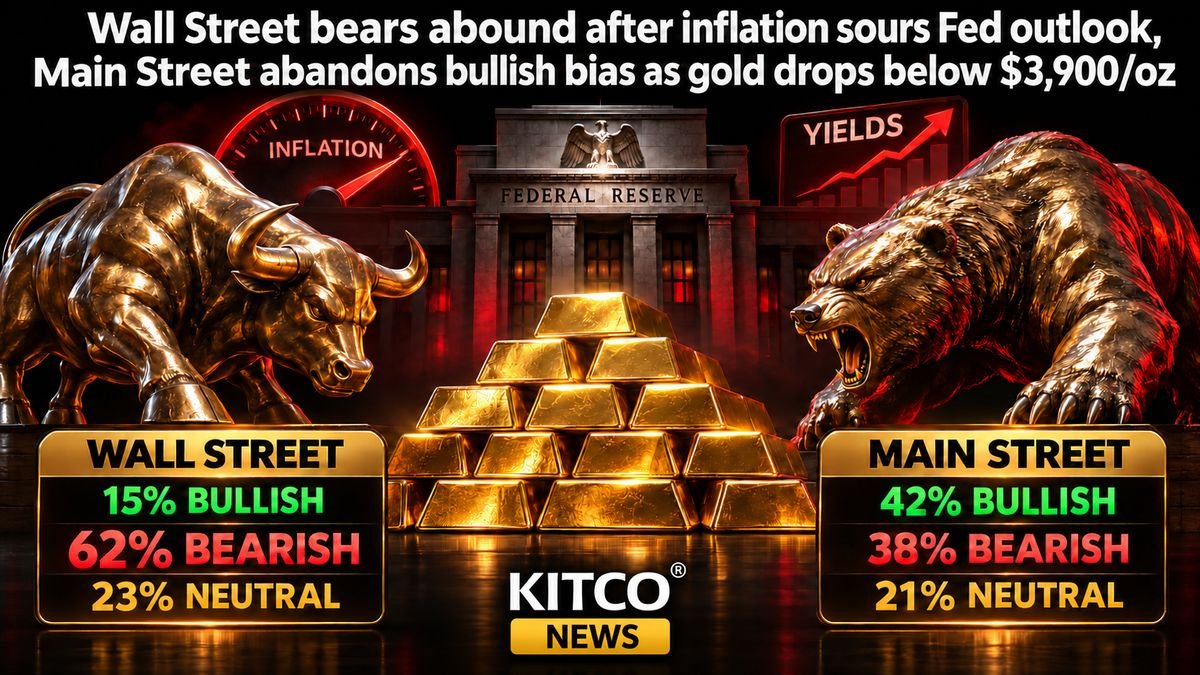
This week, 13 analysts participated in the Kitco News Gold Survey, with Wall Street maintaining a bearish outlook after gold prices fell below $3,800. Two experts, or 15%, expected gold prices to rise in the coming week, while 10 others, representing 62%, predicted further declines. The remaining three analysts, or 23%, were either uncertain about the direction or expected sideways trading.
Meanwhile, 160 votes were cast in Kitco’s online poll, with Main Street bulls falling into the minority following gold’s poor performance. 67 retail traders, or 42%, anticipated higher prices next week, while 60 others, or 38%, predicted the metal would lose value. The remaining 33 <a s still at that major support that's roughly $3,900 in COMEX futures,” he said. “I know it's slightly below there, but in order to feel more confident that this was a true breakdown, I would want to see it break with a higher margin, and it still hasn't done that.”
“It also did something similar right before the midterm, where it went right below, started triggering some stops, and then bounced again, so that’s what I’m watching right now,” he added. “It hasn’t been a clear breakdown yet.”
Colombo noted that the current support zone is not arbitrary. “It’s what has really acted as a support since one year ago, going back to the October, November [2025] lows,” he said. “And then if you draw a zone across horizontally, you can see it touched it briefly when it sold off intraday in March at the worst of the sell-off. Then it did the same thing back in June and July, hit that same support and bounced off of it. And now it’s retesting.”
“Is it down from here, or is it not? We’re really on the cusp here.”
Colombo stated that if the $3,900 per ounce support zone fails, he expects gold prices to drop by at least $400.
“There’s an air pocket from here down to around $3,400, $3,500,” he said. “So if it does indeed break, with a high enough margin, then I would expect it to head down to that next level of around $3,500.”
Looking ahead, Colombo identified the rising dollar as a primary factor.
“The dollar, when it does this, acts like a wrecking ball to precious metals,” he said. “And [the dollar index] just broke out above 102, 103. So right now, the momentum is to the upside in the dollar. Until I see that dollar rally start to top out, I’m reluctant to call a bottom. And there is a chance gold could break below $3,900 if the dollar does keep on rallying strongly like this.”
Alex Kuptsikevich, senior market analyst at FxPro, anticipates further declines for gold next week.
“Last week’s rebound in gold gave way to a fresh wave of declines, pushing the price to its lowest level since October 2025,” he said. “The rising US dollar and attractive bond yields remain the key fundamental drivers. A strengthening dollar, coupled with a 5 per cent yield on 10-year bonds, presents a compelling case against gold. The current move to new lows appears to be a resumption of the sell-off after a brief pause in early November, when some traders avoided the dollar due to the mid-term elections. Now, however, the decline has resumed as part of the downward trend towards 3,300 that we described earlier.”
“That said, the Fed could seriously stand in the way of this move if it dampens market expectations of a 50-basis-point interest rate hike in December,” Kuptsikevich added.
Analysts at CPM Group issued a ‘Stand Aside’ recommendation for gold on Friday, with an initial target range of $3,800 to $4,160 between November 13 and 27.
“Gold prices fell sharply yesterday to $3,856.70 from a recent high of $4,157.70 on 9 November, before recovering,” they wrote. “The decline, along with other metals and commodities, as well as equity prices and bond prices around the world, reflected a shift in financial market consensus attitudes: Toward higher inflation expectations, higher U.S. interest rates as a result, lower economic growth going forward, and shifting but still highly problematic political conditions both globally and domestically in several major countries.”
CPM noted that momentum for higher prices had been building since the start of November. “The move higher failed to break resistance levels in recent days, however, as the above-mentioned menu of potentially hostile developments gained prominence in the minds of investors,” the analysts said. “The lack of follow-through buying after gold rose around $160 in four trading days no doubt was one of the reasons why prices retreated sharply yesterday, following a break below the $4,000 support level.”
“Attitudes toward a 25-basis-point increase in the Fed Funds rate at the FOMC 8 – 9 December meeting have grown sharply, to 91% in the CME Fedwatch market,” they said. “There also has been increased talk of a 50 basis points increase by the Fed, either in December or in two stages, following higher than expected inflation figures for the United States in October, released earlier this week. There also has been some U.S. dollar appreciation, which typically weighs on U.S. dollar-denominated commodities.”
“This all said, the recent decline in gold prices only appears to have overflowed onto silver prices, with platinum and palladium prices being relatively less affected,” CPM wrote. “If prices manage to hold support over the next few days, they could recover quickly. In the meantime, there are various economic, financial, political, and technical forces pulling at prices on the up and downside.”
Michael Moor, founder of Moor Analytics, expects gold prices to decline again next week.
“LOWER unless we break back above the formation mentioned below,” he said. “In a Higher time frame: I cautioned on 8/16/18 the break above $1,183.0 warned of renewed strength. We have seen $4,443.1. This is ON HOLD. We held exhaustion with a 56268 high and rolled over $1,770.1. This is OFF HOLD. On a medium-timeframe basis: The trade below 52554 projected this down $740 (+)—we attained $1,398.7. The trade below 52036 brought in $1,346.9 of pressure. The trade below 51606 brought in $1,303.9 of pressure. These are OFF HOLD. We held exhaustion with a 49177 high and rolled over $1,061.0. The break below 48185 projected this down $185 (+)—we attained $961.8. The trade below 47923 projected this down $205 (+)—we attained $935.6. These are OFF HOLD.”
“On a lower timeframe basis: The break below 46369 brought in $780.2 of pressure,” Moor wrote. “The break below 45886 projected this down $205 (+)—we attained $731.9. The trade below 44227 projected this down $400 (+) max—we attained $566.0. The break below 43582 brought in $501.5 of pressure. The break back below the 42183 and 42167 lines brought in $361.6 and $360.0 respectively. The break back below 41979 brought $341.2 of pressure. The failure back below 41298 (-2.2 tics per/hour) brought in $273.1 of pressure. Tuesday, we left the bearish reversal above warned about—we have come off 224.5 from the 40812 open. The break below 40351 has brought in $178.4 of pressure. The break below 39468 (-5.7 per/hour) has brought in $90.1 of pressure; but decent trade back above should bring in decent strength again. Yesterday we left a medium bearish reversal above as well.”
“NOTE: we may be in the last stretch of the move down from 56268 on a higher timeframe, and 47550 on a medium timeframe, with possible exhaustion at 38232-8042 (medium) and 37395-7073 (higher/medium),” he added.
At the time of writing, spot gold was trading at $3,883.98 per ounce, reflecting a 5.00% loss for the week but a 0.19% gain for the day.