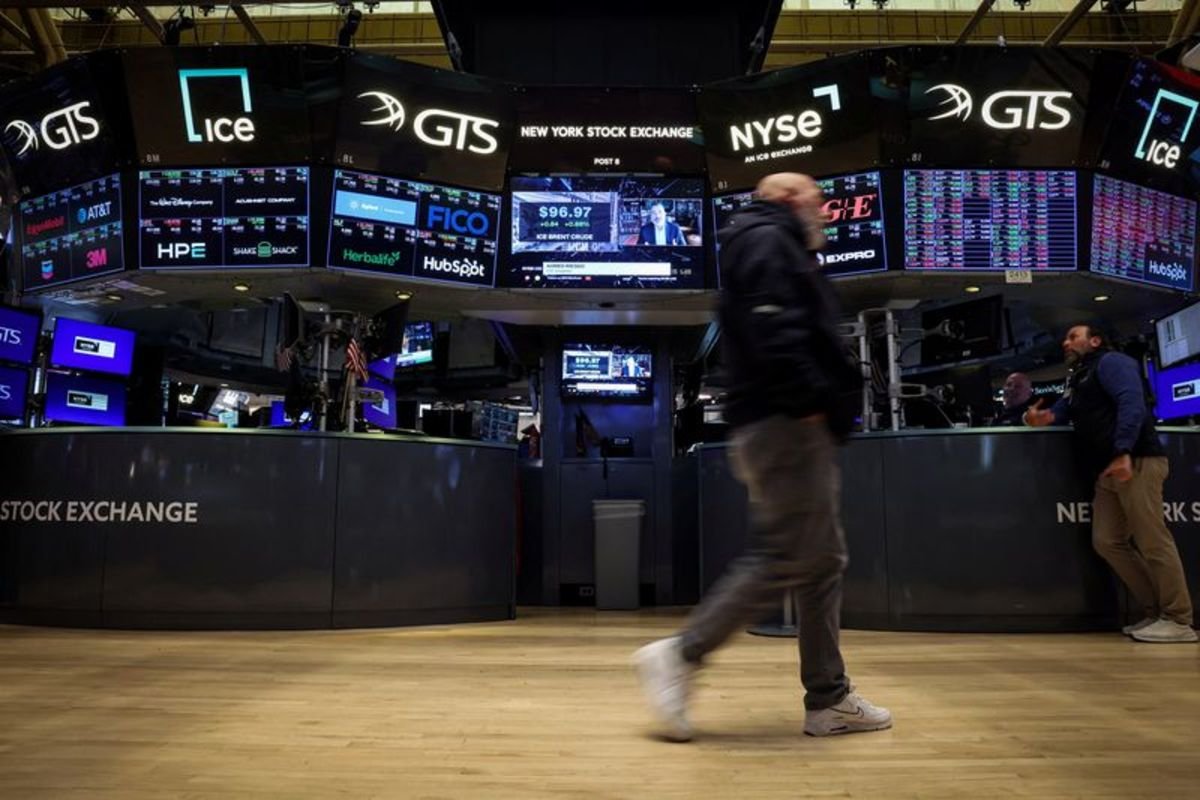
US equities continued their technology‑led decline on Tuesday, with <a s <a s massive IPO, slated for Wednesday, aims to value the Claude chatbot developer at up to $1.4 trillion.
All three major U.S. indices ended the session sharply down, with the S&P 500 and Nasdaq marking their first four‑day losing streak since September.
“Every sector in the S&P is down,” said Oliver Pursche, senior vice president at Wealthspire Advisors, in New York. “So clearly, it is a reflection of overall investor nervousness as opposed to being driven by a specific set of stocks, whether they’re AI-related or not.”
“It’s a confluence of all of the events that are there, and it seems to be speculation-driven as opposed to fact-driven,” Pursche added. “It’s not all about Nvidia.”
Nevertheless, investors seemed content with Nvidia’s earnings despite lofty expectations. The firm exceeded analyst forecasts, and its stock climbed up to 3 % in after‑hours trading.
The AI sector was already facing public resistance to massive data centers when tech stocks were shaken by the removal of Nvidia CEO Jensen Huang after disclosures of his ties to an alleged spy. Investors are also eager for returns on the huge spending by hyperscalers.
Following Huang’s exit, the Trump administration’s initiative to ban Chinese data‑center equipment imports gained traction, even as companies such as Amazon, Alphabet and Meta pushed back.
AI enthusiasm drove the Philadelphia Semiconductor Index’s YTD rise to 106 % in June, but that momentum has faded, with the index now up roughly 34 % for the year.
Early‑session economic data revealed robust underlying retail sales, a slowdown in industrial production, and higher import prices, mainly due to soaring oil costs. Homebuilder confidence fell to its weakest point since April 2012.
The Dow Jones Industrial Average dropped 848.75 points (1.64 %) to 50,759.42, the S&P 500 fell 76.06 points (1.03 %) to 7,340.53, and the Nasdaq Composite slipped 181.37 points (0.74 %) to 24,328.38.
At the sector level, software and services, airlines, and banks were the most noticeable laggards.
Software stocks fell across the board, with Salesforce, Workday, Intuit and Adobe each sliding between 4.3 % and 9.5 %.
Microsoft slipped 2.3 %, and AppLovin fell 3.9 %.
JPMorgan stock declined 2.4 % after the firm announced that insider Bregje de Best will replace Jeremy Barnum as CFO in early 2027.
FED HINTS AT AGGRESSIVE RATE HIKES
<a s release of the Federal Open Market Committee's October meeting minutes may shed light on the Fed's near‑term policy stance.
On the NYSE, declining stocks outpaced advancing ones by a 3.76‑to‑1 ratio, with 27 stocks hitting new highs and 702 reaching new lows.
On the Nasdaq, 1,273 stocks advanced while 3,527 fell, giving a decline‑to‑advance ratio of 2.77‑to‑1.
The S&P 500 logged five new 52‑week highs and ten new lows, whereas the Nasdaq Composite saw 20 new highs and 526 new lows.
Trading volume on U.S. exchanges reached 18.90 billion shares, slightly above the 18.81 billion average for the full session over the past 20 trading days.