Wall Street erased its early losses on Thursday after navigating significant volatility surrounding Nvidia’s stock and fluctuating oil prices. These market movements suggest that investors believe the artificial intelligence sector, which holds substantial influence over the broader market, will see limited fallout despite the sudden decline of one of its most prominent figures.
After dipping nearly one per cent at the opening bell, the S&P 500 quickly recovered, moving 0.3 per cent into positive territory. By 11:30 a.m. Eastern time, the Dow Jones Industrial Average had climbed 195 points, or 0.4 per cent, while the Nasdaq composite rose 0.3 per cent, successfully reversing an initial 1.6 per cent decline.
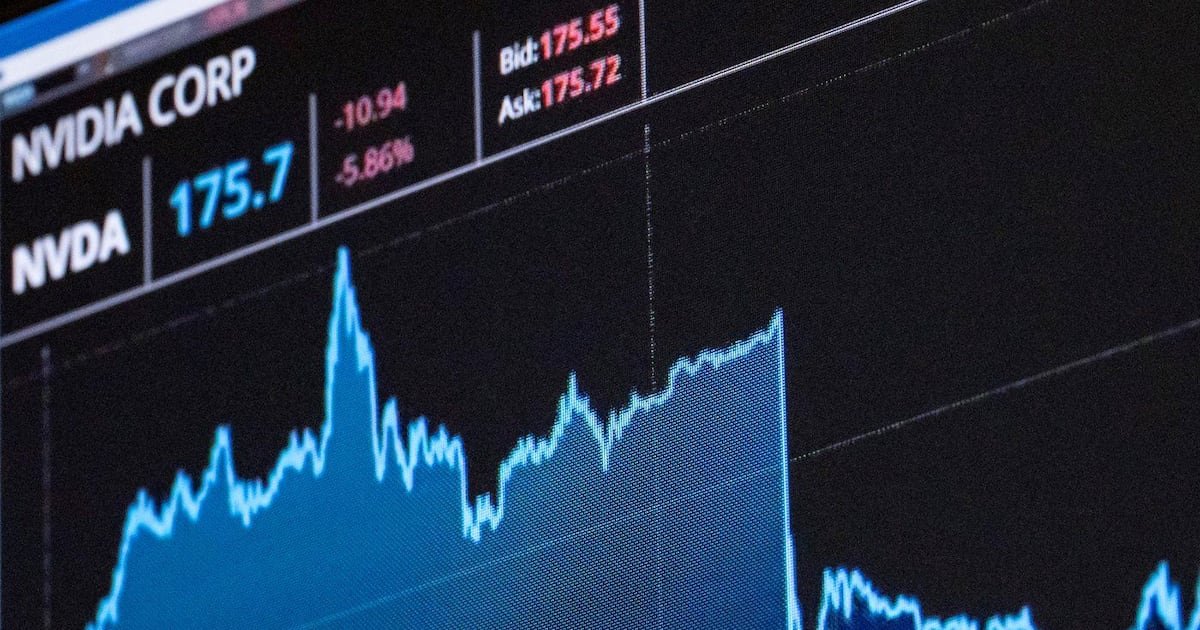
At the heart of the market turbulence was Nvidia. Its shares plunged 14 per cent at the start of trading following the resignation of Jensen Huang, the company’s CEO, co-founder, and public face. The chipmaker’s stock has been under pressure since the board launched an investigation into Huang regarding a relationship with a woman suspected of being a Chinese government agent.
It is a dramatic reversal for both Huang and Nvidia, which had become the most valuable and influential stock on Wall Street due to its pivotal role in the AI boom. The company’s share price hit a record high Wednesday amid concerns regarding Huang’s future as CEO and the company’s ability to move forward without him. The board addressed the leadership question Thursday morning by announcing Huang’s resignation and appointing Chief Financial Officer Colette Kress as interim CEO.
The second question remains unresolved, casting a shadow over the entire market, as Nvidia and the broader AI industry have been primary drivers of the record-setting performance of U.S. stocks in recent years.
Nvidia continues to sell AI chips at a rapid pace regardless of its leadership, and analysts maintain that the firm remains the industry leader. This reality helped Nvidia cut its early losses in half by Thursday, with the stock most recently trading down 4.8 per cent. This recovery provided a lift to the broader market.
Beyond Nvidia, other stocks within the AI sector experienced swings due to the ongoing uncertainty.
CoreWeave, which purchases Nvidia chips to provide cloud-based access to customers, dropped 4.5 per cent. Micron Technology, a supplier of memory for computers that has benefited from the AI frenzy, fell 2.5 per cent.
Conversely, Broadcom rose 6.7 per cent and Advanced Micro Devices gained 6.5 per cent on speculation that these rival chipmakers might capture a competitive advantage. These gains nearly offset Nvidia’s decline, which had been the heaviest weight on the S&P 500. This suggests that investors see the AI industry as expanding to include other players rather than relying solely on Nvidia.
The level of uncertainty rippling through the market was evident in GE Vernova, which supports AI data centers; the stock flipped from an early 3 per cent loss to a 2.9 per cent gain.
The U.S. market also found support from gains in the oil and gas sector. Marathon Petroleum rose 2.6 per cent, and ExxonMobil added 1.2 per cent.
These companies benefited from rising oil prices after U.S. President Donald Trump stated he is no longer interested in a deal with Iran to end their conflict. Instead, Trump noted he had asked his vice president to investigate U.S. cities and states governed by Democrats.
“We don’t need a deal with Iran,” Trump said. “Those days have long since passed. We’ve got their money, Hundreds of Billions of Dollars, and we’ve got their Strait!”
The price of a barrel of Brent crude oil jumped from approximately US$92 to over US$94 following Trump’s statement before easing slightly. It was most recently trading at US$93.77, up 1.1 per cent.
Oil prices have been highly volatile since the United States and Israel began the war with Iran in late February, fluctuating between roughly US$70 and US$150.
Rising oil prices have intensified inflation concerns, pushing the yield on the 10-year Treasury to 5.08 per cent from 4.98 per cent late Tuesday. The bond market had been closed Wednesday for Veterans Day.
Higher yields increase borrowing costs for everyone, from the U.S. government and companies building AI data centers to individuals purchasing homes. Elevated mortgage rates contributed to U.S. sales of previously occupied homes in October falling to their slowest pace in more than 16 years.
While the housing sector has slowed the U.S. economy, it has not derailed it. A separate report released Thursday indicated that while slightly more U.S. workers filed for unemployment benefits last week, the total remains low by historical standards.
In international markets, indexes in Europe ticked higher following a weaker finish in Asia.
Hong Kong’s Hang Seng index fell 1.3 per cent, marking one of the most significant moves globally.