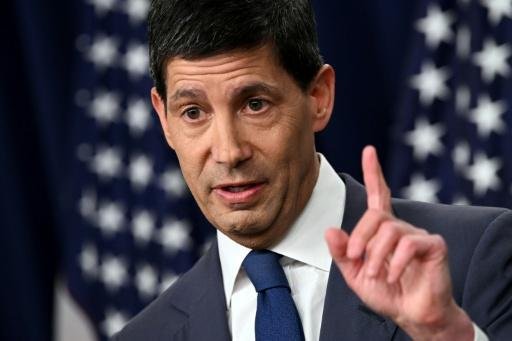
The US inflation that has remained “too high” for “too long.”
The Federal Open Market Committee reached a unanimous decision to increase rates by 25 basis points, bringing the target range to between 3.75 and 4.00 percent.
“The plain fact is that inflation is too high, and has been for too long,” Warsh stated during a press conference, characterizing the move as a “serious” but essential step.
This week’s increase may not be the final one; according to the Summary of Economic Projections (SEP), a significant majority of Fed officials signaled that at least one additional hike will likely be needed before the year concludes.
American households and businesses have struggled under years of inflation exceeding the Fed’s target. Prices have climbed sharply following the onset of Trump’s conflict with Iran, his specific tariff <a raise against Trump" and characterizing the Fed’s rate-setting body as "hostile" and politically motivated.
Since taking office, the president has challenged the Fed’s traditional independence, even attempting to remove a Fed Governor and initiating a criminal investigation into Warsh’s predecessor in his push for lower rates to stimulate the economy.
Unlike his frequent public attacks on former Fed chair Jerome Powell, the president’s comments on Wednesday did not include direct insults or personal criticism of Warsh.
Trump’s Republican Party faces a difficult challenge in the upcoming midterm elections, as Democrats aim to regain control of both chambers of Congress while voters remain focused on economic concerns.
The Fed had maintained steady rates since January, opting to observe the economic impact of energy price shocks stemming from the Iran war and the broader effects of tariffs on consumer costs.
However, since July, an increasing number of policymakers have suggested that a rate increase was necessary to curb inflation as the conflict continues and energy prices remain elevated.
August’s consumer price index, released on Friday, showed inflation at 3.4 percent. While this figure remained unchanged from the previous month, it continues to sit well above the Fed’s long-term target of two percent.
Diane Swonk, chief economist at KPMG, noted that inflation had “forced the Fed’s hand.”
“Price pressures remain too elevated and too persistent for policymakers to look through, while the economy and labor market have held up well enough to absorb tighter policy,” she said.
In its SEP, the Fed increased its year-end forecast for the Personal Consumption Expenditures (PCE) price index—its preferred inflation metric—by 0.1 percentage points to 3.7 percent.
Additionally, the Fed raised its projection for GDP growth by the end of the year to 2.3 percent, an increase of 0.1 percentage points.
Warsh reaffirmed his confidence in the “resilience” of the US economy, pointing to its strength as evidence of its capacity to withstand tighter financial conditions.
While US stock markets had largely anticipated Wednesday’s rate hike, indices still fell following the announcement, a common reaction as investors recalibrate their holdings.
Yields on 10-year US Treasury bonds, which have risen recently due to uncertainty regarding long-term inflation, climbed past the five-percent mark, indicating that market volatility remains a concern.
Warsh assumed his role following a contentious Senate confirmation process, during which Democratic lawmakers alleged he acted as a “sock puppet” for Trump—a claim he has denied.
The Fed operates under a dual mandate to achieve maximum employment while maintaining inflation at its two-percent long-term goal.
The central bank primarily manages these objectives by adjusting the benchmark US interest rate; lower rates generally encourage economic activity but can drive inflation, while higher rates are used to cool both prices and activity.
The Fed’s SEP indicated that at least 12 of the 18 policymakers involved in the projections anticipate that one more rate hike will be required before the end of the year.
Four officials indicated they expect two additional rate increases will be necessary.
Warsh has previously criticized the Fed’s practice of issuing such projections and did not participate in the prior iteration held in June.
This latest projection included only 18 policymakers, suggesting that he once again opted not to contribute his own forecast.
Latest stories
SportsHamilton gives thumbs up to Gulf GPs despite Iran conflict
Lewis Hamilton stated on Wednesday that he hopes this year’s Formula One world championship will conclude with its two scheduled races in the Middle East.
EuropeZelensky says Putin using fighters from 47 countries in Ukraine war
Ukrainian President Volodymyr Zelensky accused his Russian counterpart Vladimir Putin of utilizing foreign fighters from 47 different nations to support Moscow’s military efforts in Ukraine.
SportsLeclerc admits going ‘too far’ in Hamilton shunt in Italy
Charles Leclerc dismissed reports of a conflict with Ferrari teammate Lewis Hamilton on Wednesday, joining other competitors in praising the driver’s performance.