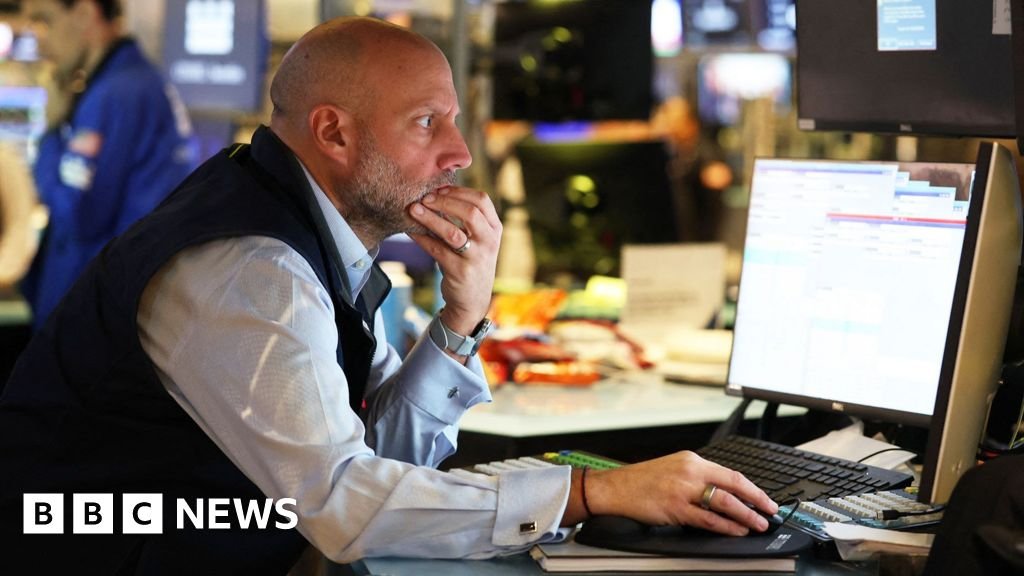
AI stocks climb after trillions wiped from market values
Shares in artificial intelligence and technology companies have staged a partial recovery following a massive sell-off that erased trillions of dollars in market capitalization.
The tech-heavy Nasdaq index finished the session in positive territory, rebounding from a market rout that originated in the US on Thursday before spreading to Asian and European exchanges on Friday.
stock market, with chip and semiconductor manufacturers hit particularly hard.
The Nasdaq Composite recovered slightly on Friday, ending the day up 1.1% and recouping some of its previous 5.5% decline.
The S&P 500, which tracks the largest publicly traded US firms, closed up 0.3%, while the Dow Jones Industrial Average remained largely flat before finishing with a minor 0.4% loss.
Major companies that had seen hundreds of billions in value evaporate, including Nvidia, SpaceX, and Tesla, managed to regain some ground on Friday.
Conversely, stock markets across Asia and Europe performed more poorly.
South Korea’s Kospi index closed down 6% on Friday, with shares in chipmaker SK Hynix plummeting more than 10%. European markets also saw declines, with major indexes in Germany, France, and Spain ending the session in the red.
In the UK, the FTSE 100, which tracks the largest companies on the London Stock Exchange, fell by 1.01%.
Beyond the recent market volatility, UK traders were also processing the Bank of England’s latest decision to raise interest rates, alongside signals that further hikes could be necessary to combat rising inflation.
‘Market purgatory’
These market fluctuations follow the sweeping Democrat victory in the midterm elections.
Several Democrats campaigned on platforms calling for new rules and regulations regarding artificial intelligence and data centers. The party has since secured control of both houses of Congress, as well as key victories in states central to the AI data center expansion.
US President Donald Trump reiterated his support for what he terms “super intelligence” on Friday, stating that only “foolish leadership” would “say no to the riches they bring”.
Nevertheless, questions remain regarding whether the massive capital expenditure currently flowing into AI will ultimately yield a return.
Russ Shaw, founder of the global tech advocacy group Tech London Advocates, suggested the election results signal that a strategic rethink regarding AI is required.
“The incoming Congress is going to really focus on AI in a very dramatic way,” he told the BBC’s Business Today.
“I’m a big fan of AI, but I’m watching what these companies are doing, and they’re not communicating effectively at all, particularly in the US, about what the benefits of AI are all about.”
Pierre Baqué, chief executive of the AI platform Neural Concept, described the share price movements as a “necessary market correction” that highlights legitimate concerns about the scale of investment being directed toward AI infrastructure.
“The industry must move beyond unchecked infrastructure investment and demonstrate greater financial discipline,” he said.
“We are entering a critical transition phase, a market purgatory where raw tech must prove its widespread economic value.”
Dan Coatsworth, head of markets at AJ Bell, noted that it had been a brutal week for investors, adding that the primary question is whether the gains in the S&P 500 and Nasdaq can be maintained.
“Once investors have had the weekend to catch their breath, next week could give a clearer indication of whether the tech trade is going down the pan or fighting back.”
Could the US midterms put a pin in the AI bubble?
Elon Musk appears to signal the end of the road for Cybertruck
Strong jobs figures could ease market fears
In addition to the fallout from the midterms and the decline in AI stocks, US traders are also evaluating the latest employment data.
The figures were stronger than anticipated: US employers added 165,000 new jobs in October, a figure well above the average monthly increase and more than double what analysts had predicted.
The overall <a The US economy is running hard which may mean the risks the markets are worrying about at the moment are not such a risk to the real economy as is being feared," he said.