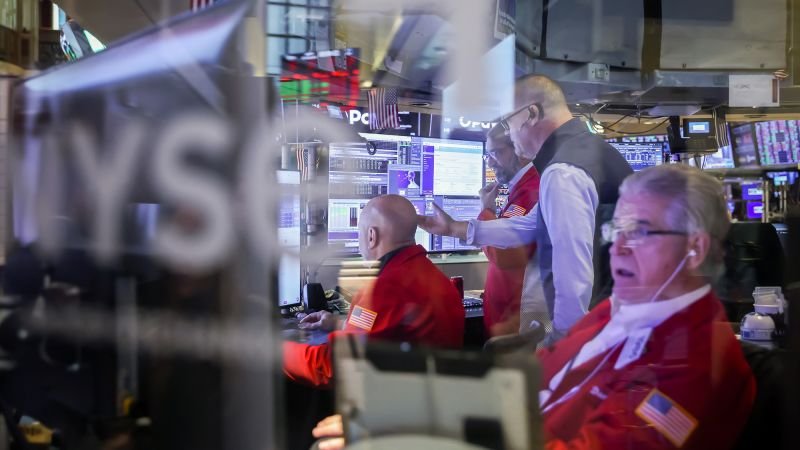
Traders worked on the floor of the New York Stock Exchange on Friday, Oct. 30, 2026.
earnings reports reignited fears that massive capital expenditures on artificial intelligence might fail to yield the returns investors demand.
The Nasdaq Composite tumbled 2.86% and the S&P 500 declined 1.82%, with both indices recording their worst daily performance since June. The Dow Jones Industrial Average shed 572 points, or approximately 1.1%.
Only a few weeks ago, the Nasdaq and S&P 500 were hitting all-time highs. However, market sentiment soured this month due to persistent concerns regarding elevated interest rates, tech firms burning through cash for AI infrastructure, and underwhelming earnings guidance.
The Nasdaq has retreated 7.8% from its record high earlier this month and logged its steepest monthly decline since March 2025. The S&P 500 is down roughly 3% from its recent peak.
Intel shares plummeted 28.58% on Friday—marking the company’s worst day since 1974 and its second-worst on record—after the firm issued soft fourth-quarter guidance, citing a sluggish PC market and higher memory chip costs that are dampening consumer demand.
Amazon stock also retreated, falling 1.4% after an earnings report revealed continued increases in AI spending alongside sales and profit figures that missed analyst expectations.
This follows a 12% drop in Alphabet shares on Thursday, which erased half a trillion dollars in market value from America’s fourth-largest company. Investors reacted negatively to a slowdown in Google’s search advertising business and ballooning AI costs. Alphabet shares dipped another 1.4% on Friday, concluding their worst month on record.
Anxiety surrounding the AI boom also weighed on other semiconductor manufacturers: Nvidia shares fell 4.2%, and a key index tracking chipmakers sank 7.2%.
Alphabet, Microsoft, Meta, and Amazon are collectively pouring hundreds of billions of dollars into data center construction. After previously cheering any AI-related development, Wall Street is becoming more selective about which companies are spending prudently and generating tangible returns.
Friday marked the end of a difficult month for AI-related stocks as investors continue to scrutinize the massive costs of the AI boom, demanding proof that these investments will eventually drive profitability.
“We’re moving out of the hopes and dreams phase of the AI trade and into the ‘show me’ phase,” Joe Tigay, portfolio manager at Equity Armor Investments, said in a note.
“Full order books are great, but investors want to see who can actually deliver, turn that demand into earnings and generate cash,” he said.
Alphabet’s earnings report on Wednesday sparked fears that Google’s core search advertising revenue is being threatened by users shifting toward AI chatbots instead of traditional search engines.
Alphabet’s promise of returns from AI “is getting pushed even further down the road,” Matt Maley, chief strategist at Miller Tabak + Co, said in a note. “It raises the question as to whether the payout will be as big as they have been promising.”
As Big Tech accelerates spending, investors are growing uneasy about the impact on corporate balance sheets. Alphabet recently reported two consecutive quarters of negative free cash flow for the first time on record as AI investments ramp up while revenue growth lags behind expectations.
Meta disclosed a quarter of negative free cash flow last week for the first time since 2012. On Thursday, Amazon announced negative free cash flow of $42.4 billion over the past 12 months as it intensifies its AI-related spending.
“Investors don’t just want capex, they want to see the returns already,” Neil Wilson, a strategist at Saxo Markets, said in a note. “For the wider AI trade, we are starting to see a more critical evaluation of the return on investment from this monster AI splurge.”
Alphabet and Meta are currently in a bear market, having fallen more than 20% from their respective peaks in May and August 2025. In contrast to Alphabet, Meta, and Amazon, Microsoft reported $18.6 billion in positive free cash flow this past quarter, and its stock is down only 4% from its record high earlier this month.
Investors are increasingly viewing the race to secure capital—ring a new, more difficult phase. Higher interest rates are also pressuring riskier, debt-dependent segments of the AI buildout, further fueling market jitters
Anthropic’s highly anticipated IPO filing on Monday provided a temporary boost to tech stocks before sentiment soured mid-week following Big Tech earnings reports.
“The AI trade is down, but not out,” said Paul Stanley, managing director at Arca, in a note Friday morning. “This is not the first tech and AI correction, and it won’t be the last. We are still in the very early stages of AI development, and pullbacks are par for the course.”
Adding to the market’s unease on Friday, Bitcoin dropped more than 4% over the last 24 hours to its lowest level in over a month, following reports that the world’s largest crypto exchange had been hit by a record-breaking heist.
Following a massive rally this year, investor expectations for chipmakers have climbed, leaving companies struggling to impress Wall Street. Despite losing nearly a third of its value on Friday, Intel shares remain up 78% for the year.
“A lot of these names, Intel is no exception, they just had a phenomenal year already. So, there’s definitely some profit taking as a result,” said Mike Dickson, head of research and quantitative strategies at Horizon Investments.
As investors offloaded tech holdings, they rotated into defensive market segments, such as consumer staples and government bonds.
Other areas of the tech sector have also been rattled as investors demand evidence that companies will benefit from, rather than be threatened by, AI advancements. Shares of software firm ServiceNow plunged 27% on Thursday—their worst day on record—after profit results slightly missed Wall Street estimates. ServiceNow fell an additional 4% on Friday.
“The market doesn’t like uncertainty,” said Ted Mortonson, a tech strategist at Baird. “People just get out of the way until they can figure it out.”