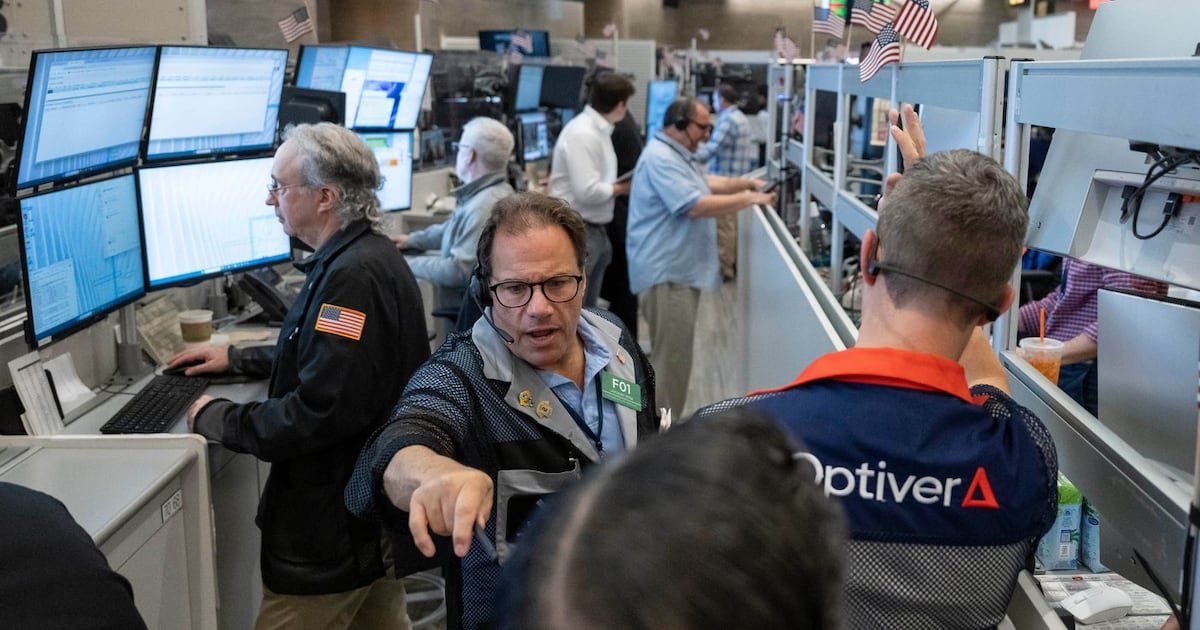
U.S. stock indexes pushed higher on Thursday, driven by companies reporting stronger-than-anticipated inflation and other ongoing concerns weighing on the markets.
Kimberly-Clark rose 4.7 per cent after the parent company of Huggies, Kleenex, and Kotex announced that it expects quarterly revenue and profit to surpass analyst forecasts. Bank of New York Mellon gained 3.2 per cent following a stronger-than-expected profit report, with CEO Robin Vince noting that BNY experienced strength across its various regions.
Markets were significantly more unstable earlier in the day. A sell-off in AI stocks that originated on Wall Street Wednesday rippled globally, causing South Korea’s Kospi index to drop 7.6 per cent and Japan’s Nikkei 225 to fall 4.9 per cent, which subsequently pressured the S&P 500 at the start of Thursday’s session.
These represent the latest turbulent shifts for AI stocks, which have led the market for several years. Corporations are investing heavily in the technology, aiming for increased productivity and higher profits. However, the high costs associated with AI chips and data centers have forced many firms to rely on borrowed capital.
Now, with global bond yields reaching multi-year highs and increasing the cost of borrowing, investors are questioning the durability of this spending surge. Furthermore, elevated bond yields typically reduce investor appetite for expensive stocks, particularly those with high valuations.
Nvidia, the chipmaker that has become Wall Street’s most valuable company during the AI boom, fell 1.8 per cent and served as the largest drag on the S&P 500. The stock entered the day with a gain of nearly 1,415 per cent since the end of 2022.
However, losses in the AI sector eased as the day progressed, helping to stabilize broader U.S. indexes. Nvidia managed to cut its early-morning loss, which had reached 3.8 per cent, by more than half.
Taiwan Semiconductor Manufacturing Co.’s U.S.-listed shares dropped as much as 5.3 per cent in the morning before closing with a more modest 1.8 per cent decline. The industry bellwether reported quarterly profits that beat high analyst expectations, and Chief Financial Officer Wendell Huang said it expects strong demand to continue in the final three months of 2026.
CoreWeave, a provider of cloud-based AI computing power, fell as much as 9.5 per cent early in the day following a 15.5 per cent drop on Wednesday. The stock later reversed course to finish with a 5.9 per cent gain.
In total, the S&P 500 rose 25.12 points to 7,744.06. The Dow Jones Industrial Average jumped 556.21 to 52,177.69, and the Nasdaq composite added 20.16 to 26,713.03.
In the bond market, Treasury yields declined, indicating that investors were willing to pay higher prices for U.S. government debt. Treasurys are often viewed as a safer asset, and investors frequently move toward them during periods of market anxiety.
The yield on the 10-year Treasury fell to 5.09 per cent from 5.19 per cent late Wednesday. It had exceeded 5.30 per cent earlier this month, reaching its highest level since 2002 due to inflation concerns, signs of a robust U.S. economy, and other factors.
The decline in yields occurred even as a new report suggested that U.S. inflation has increased more than economists had anticipated.
Several other reports on the U.S. economy also outperformed economist expectations, which usually exerts upward pressure on yields. One report indicated that U.S. retailers generated more revenue last month than projected, while another showed that fewer Americans filed for unemployment benefits last week than expected.
In international markets, the decline in South Korea was the most significant. The Kospi index, which is heavily weighted by chipmakers Samsung Electronics and SK Hynix, suffered its worst day since July. It has fallen 39 per cent since reaching a record high in June.
Indexes were stronger in Europe, where there is less reliance on technology stocks. London’s FTSE 100 rallied 1.1 per cent, marking one of the strongest performances globally.